
Embarrassment
how important is being earnest anyway?

There is a chart that I have seen over and over again circulating the internet; it depicts a venn diagram of things that are terribly embarrassing and things that make life worth living. The venn diagram, of course, is just a circle. What I had not seen, until recently, is the reflection that accompanies the diagram. Katie Bird’s piece “Embarrassment Has Good Bones” is a much better discussion of this notion than I have the ability to articulate. It seems to put into words my tangle of feelings about what makes up embarrassment.
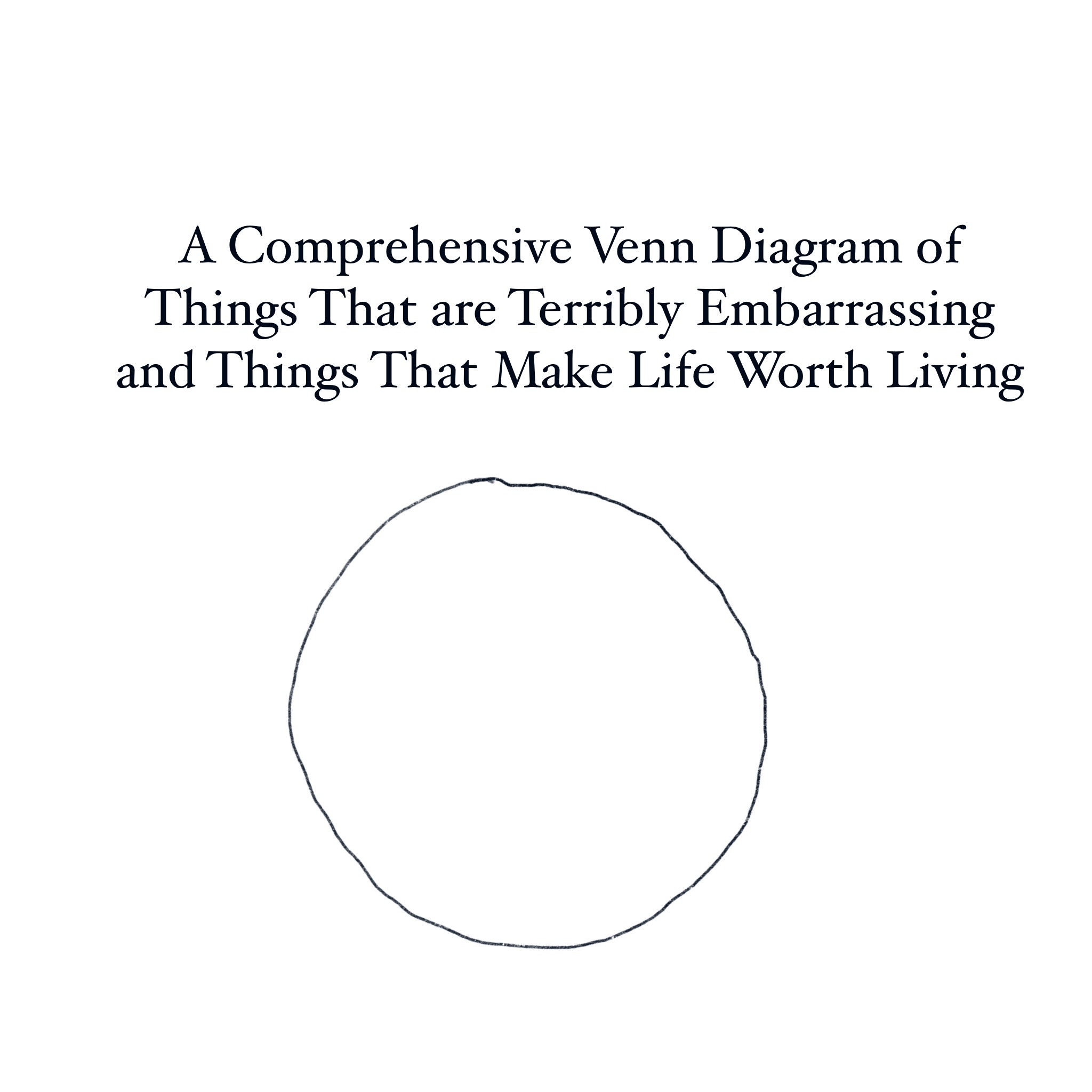
At the same time, Bird’s discussion kind of contradicts my life’s mantra. She claims that “the only way to live a life without embarrassment is to simply not care about your actions or how others perceive them, to always have your guard up and play your cards close to your chest,” which goes directly against my oft-repeated statement that “embarrassment is a choice.” To me, “Embarrassment is a choice” suggests that we may live absolved of embarrassment while still being fully realized people.
It’s also the kind of thing that a person prone to generally embarrassment-inducing tendencies says. It’s a way of brushing things off–in saying it we suppose we are somehow freed of our own potential feelings. It fundamentally demands an interrogation of what constitutes something that is “embarrassing.” Unlike most emotions, it’s not a solely internal feeling – I am sad about this, I am angry about that – but rather how we feel about other people’s perception of us. Embarrassment is a social emotion. Ever been alone and done something “stupid” and still felt yourself blush? Foucalt would tell you that that’s simply how deep our understanding of a surveillant social world permeates into us.
So do I really get to decide if embarrassment is a choice? If it doesn’t matter how I feel about it but other people still think it’s embarrassing, is it embarrassing? What about the other way around? What if (and this is my hypothesis about most of life) we worry about how what we do is seen as embarrassing and in fact, no one is paying attention? Is it really “only embarrassing if you’re embarrassed?” I do not have the answers to this, nor do I really think it’s actually that worthwhile of a paradox. Pretty much the same old thing as wondering what happens if a tree falls in the woods and no one is around to hear it. (I do not know).
All that said though, I do think that I am kind of built hard-wired for embarrassing situations, and saying that embarrassment is a choice saves me from berating myself for, more often than not, enjoying life with full muster. I am clumsy and loud and brash; I like singing and sporadic dancing and general merriment. For better or worse, people have suggested that I am unyielding in who I am–the kind of purported devotion to authenticity lauded at summer camp and more of a dubious trait in my high school’s halls. I don’t know how true that is because I feel that I am a complete and total product of my social world and also spent plenty of hours – mostly between the ages of 12 and 18 – trying to figure out how to be less weird. I also think (and have said before) that people who never shut up about being openhearted and honest are often full of shit because they’re spending more time talking about their own need to be authentic than actually living openhearted and honest lives. We aren’t all Brené Brown.
Also – and this is with a confessional tone – I have an intense need to get people to pay attention to me (a trait we often categorize as embarrassing anyway) – which often comes at the cost of being loud/ inappropriate/ bizarre/ sporadic/ odd. It’s a little chicken-and-the-egg whether this love of attention or my qualities conducive to embarrassment came first; my logic tells me that it’s probably a little bit of each feeding the other. But when I say or do things knowing that they’re embarrassing are they really all that? If you can control the narrative then is it really embarrassing? Nora Ephron (my hero) often cited her mother’s maxim that “everything is copy.” Ephron wrote that she
“believe[d] that what my mother meant was this: When you slip on a banana peel, people laugh at you. But when you tell people you slipped on a banana peel, it's your laugh, so you become a hero rather than the victim of the joke.”

It’s the difference between singing karaoke in a silly, ha-ha, I’m singing Tina Turner kind-of-badly way, and singing in earnest – trying.

A scene in one of my favorite movies -- My Best Friend's Wedding-- with real, vulnerable karaoke
I have class-clowned my way through enough meals and meetings and life to know this and to cherish this. At the same time I realize that there is almost nothing more painful than watching someone try and fail at being funny. My dear friend refused to come to a stand-up performance I once did because he worried he would feel too keenly embarrassed by the bald vulnerability that it demands. This, notably, is coming from a boy who does a cappella. To each their own, I say.
But he had a point. Trying, in earnest, with sincerity, is equal parts huge potential for embarrassment and an enormous show of strength. I may remain adamant that we own our stories and own who we are, but at what point is making everything ‘copy’ just couching our authenticity? I don’t know – but I’m certainly not sold on the idea that humor and earnestness are all that mutually exclusive. As one of my friends once told me, you can do something “for the bit” – but you’re still doing it!
So when we do dare to take what is “embarrassing” and claim it as our own, it’s important to remember that we have some control over what we do and don’t tell anyway. Nora Ephron once made that point too. In an age where there is a platform to share absolutely anything and everything, it can feel like sharing our embarrassing stories with the wider world functions as some sort of catharsis – by unleashing it on the wider world we no longer must bear it alone. I believe that this can be both tremendously helpful and also open us up to opportunities to leave some utterly alarming digital footprints. In Yes Please, Amy Poehler (yet another hero of mine) recounted how she once went in for a cold audition where she was asked to sit on a stool and share her most embarrassing moment, and she refused. Poehler states how
“everybody wants you to share your MOST EMBARRASSING MOMENT all the time, and [she is] here to tell you that you don’t have to. You don’t have to tell it or tweet it or Instagram it. You don’t have to put it in a book or share it with anyone who doesn’t feel safe or protective of your heart.”
I think this is true – that your embarrassment can be privately your own and you shouldn’t feel compelled to bare it all if it’s not a story you want to own publicly. I also think it’s true that embarrassment lives in the heart.
Songwriting is one of those things that awes me with the simultaneous way it demands vulnerability and allows individuals to own their story. I worship at the altar of Taylor Swift and Carly Simon, Sheryl Crow and Ms. Lauryn Hill, Alanis Morisette and Stevie Nicks. And more. There are plenty of things I could say about female agency and the written word that I’ll save for another time, but the point is that songwriting amazes me. I’m content to write these odd essays and shoot them off into cyberspace (granted, a not-too-public cyberspace) or hanker for another opportunity to ramble jokes into a microphone, but remain astounded at how people find ways to share how things happened and how they feel through word and melody.
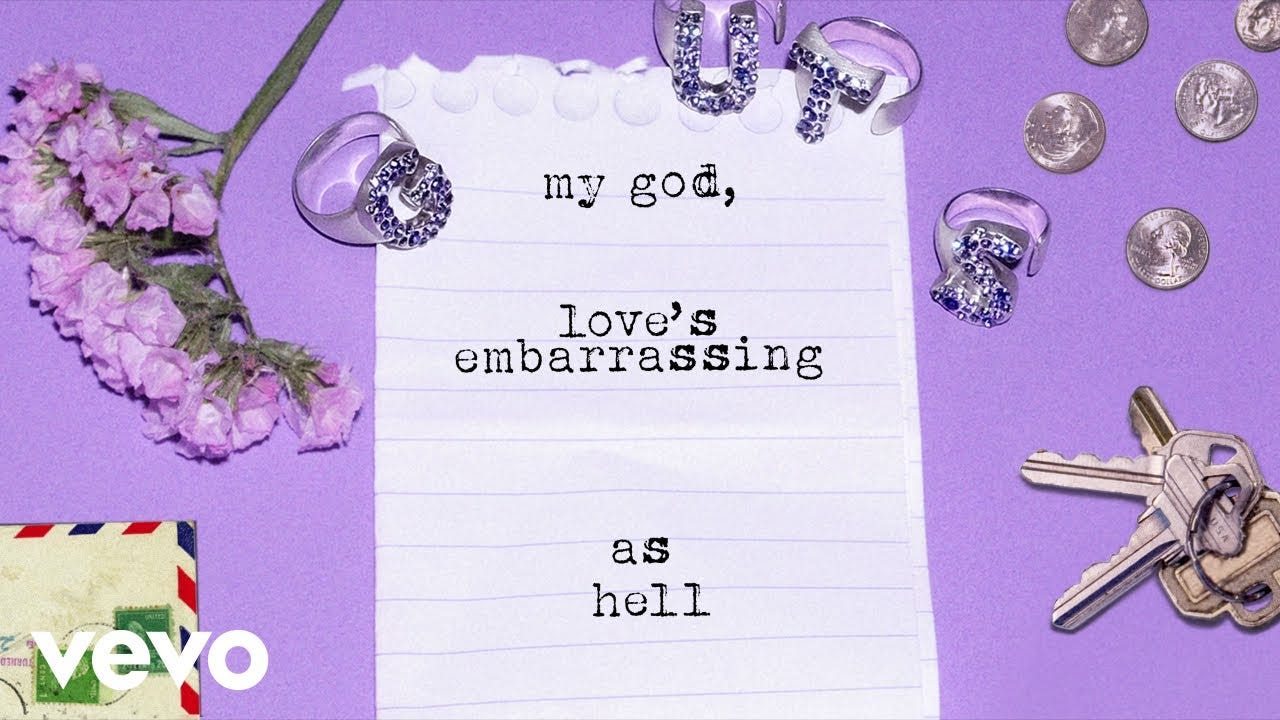
Partially because she’s enormously talented and partially because she’s my age and seemingly puts all the things I experience into song, I love Olivia Rodrigo. And I really love her song “love is embarrassing.” Especially the twangy guitar version she played at a recent Tiny Desk Concert. The song, alongside being very catchy, speaks to the single most vulnerable experience we can have – trying to find love. “Just watch,” Rodrigo sings, “as I crucify myself.” Yeah. I agree with her. Love is embarrassing – and trying to masquerade indifference to avoid the pain of emotional vulnerability is, unfortunately, a fairly futile exercise (doesn’t mean we don’t try!). But closing ourselves off to the most incandescent moments of life – love! laughter! music! dancing! – to avoid the sting of social rejection – means closing ourselves off to pretty much everything that makes being part of a social world so wonderful anyway. Which was pretty much Katie Bird’s point–that embarrassment is at the crux of what makes life worth living.
So while we may own our certain moments of loudness or clumsiness or whatever, making them part of our narrative and embracing who we are rather than categorizing them as embarrassing, there will still always be the things that cut us off at the knees, no matter how “comfortable with discomfort” or “open and authentic” you might purport yourself to be. That’s love. That’s life. Messily and, I guess, necessarily, kind of embarrassing.
(Ew.)
(That last sentence is grossly earnest. And embarrassing.)